
How to calculate cost per portion
Cost per portion is the foundation every other margin metric builds on: food cost %, gross margin %, gross profit, and suggested price.
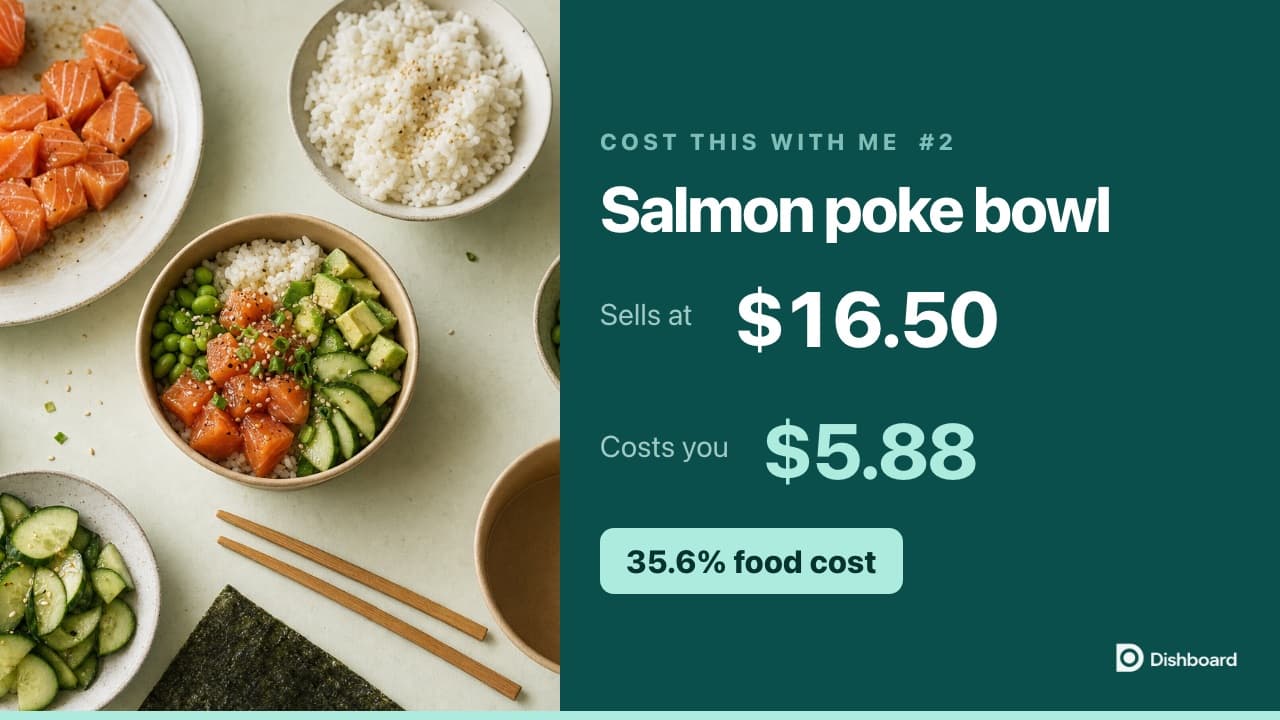
Cost per portion is the total cost of everything that goes into one serving: every ingredient, every prep recipe component, and every extra cost. If the recipe makes a batch, divide the batch cost by the number of portions it actually yields.
Cost per portion = total batch cost divided by portions the batch yields
Packaging is costed separately, on top, because the same dish carries a box on delivery and nothing at all dine-in.
Worked example: a beef chili bowl
The chili is a prep recipe. One batch yields 12 portions:
- Ground beef, 2 kg at $9.90/kg: $19.80
- Kidney beans, 1.2 kg at $2.75/kg: $3.30
- Chopped tomatoes, 2 kg at $1.90/kg: $3.80
- Onions, 0.9 kg at $1.60/kg: $1.44
- Spices and stock: $2.66
Batch cost = $31.00. Cost per portion of chili = $31.00 divided by 12 = $2.58
The bowl also takes 80 g of dry rice at $2.50/kg, which is $0.20.
Total cost per portion = $2.58 chili plus $0.20 rice = $2.78
What follows from that one number
The bowl sells for $11.00. Every other metric is now a single step away:
- Food cost %: $2.78 divided by $11.00 x 100 = 25.3%
- Gross profit: $11.00 minus $2.78 = $8.22
- Suggested price at a 30% food cost target: $2.78 divided by 0.30 = $9.27
The suggested price is a floor, not a recommendation. This bowl already sells for $11.00, comfortably above the $9.27 needed to hit target, so there is nothing to fix here.
This is why an error in cost per portion is not one error. It is the same error repeated in the food cost %, the gross profit and the suggested price, because all three are computed from it.
The two mistakes that break this figure
- Costing the batch but not the yield. A batch that is supposed to make 12 portions but actually plates 10 puts the chili at $3.10 rather than $2.58, so the bowl costs $3.30 and not $2.78, a 16% understatement that never shows up anywhere.
- Costing raw weight where the recipe uses trimmed weight. Buy 2 kg of beef, lose 8% to trim, and the 2 kg you paid for is 1.84 kg on the line. Yield percentage handles this so the portion cost reflects what you actually paid.
Frequently asked questions
- What should be included in cost per portion?
- Every ingredient, every prep recipe component and every extra cost in one serving. Packaging is excluded, and costed separately per channel.
- Does cost per portion include packaging?
- Not in the recipe figure. Packaging is tracked separately so the same dish can carry a box on delivery and nothing dine-in, without distorting the recipe cost itself.
- What if my recipe yields an uneven number of portions?
- Divide by the number it genuinely yields, not the number you planned. If a batch is meant to make 12 and reliably makes 10, the honest divisor is 10.
- Does labor belong in cost per portion?
- No. Cost per portion is a food cost figure. Labor belongs in prime cost, which adds total labor to total cost of goods sold and is measured across a period, not per dish.
Read the transcript
Salmon poke bowl, $16.50 on the menu. Looks healthy, looks expensive to make, and most kitchens cost this one wrong. They get it wrong on the very first line.
Five things go in. 120 grams of salmon. Hold that one, we are coming back to it. 60 grams of dry sushi rice at $3 a kilo, 18 cents. 30 mils of poke sauce from a house batch, and that batch works out at $6 a liter, so another 18 cents. Avocado, edamame, cucumber, and nori, $1.37. And the bowl, the lid, the chopsticks, 55 cents. That leaves with the customer, so it counts.
Now the salmon. Your invoice says $21 a kilo, so 120 grams costs $2.52, right? No, because you do not serve the whole kilo. Skin, pin bones, bloodline, the thin end of the belly. Trim a side down to clean cube, and you keep about 700 grams, a 70% yield. So the fish that actually reaches a bowl costs you $30 a kilo, not 21. Your portion is $3.60. That is $1.08 a bowl, 60 bowls a day. And there is $23,000 a year you thought you had.
So add it up, $5.88. Against $16.50, that is a 35.6% food cost, and $10.62 of gross profit on every bowl.
Here is the part that should worry you. Salmon is 61% of this bowl, so the bowl does not really have a food cost. The salmon does. Your supplier puts fish up $3.50 a kilo. That happens. You are at 39.3%, or nobody touches the price, and the scoop just drifts. 135 grams instead of 120. Nobody can see 15 grams. 38.4. Either one puts you in the red.
So is 35.6 good? For a grain or salad bowl, you are aiming at 28 to 33. So, no. And here is the thing. Cost that salmon straight off the invoice, and this bowl reads 29.1, on target. Same bowl. The only difference is whether you counted the trim. Then there is delivery. The platform takes 30% and you buy the bag. $10.62 dine-in becomes $5.02. Less than half for an identical bowl.
Cost yours the same way. It's free, no card, dishboard.co. And if you want more of these, subscribe.
Add your ingredients line by line and get a cost per portion. You can save it and carry it into Dishboard afterwards.
Free, and no account needed.
Free tools
Put the math to work in seconds. No signup required.